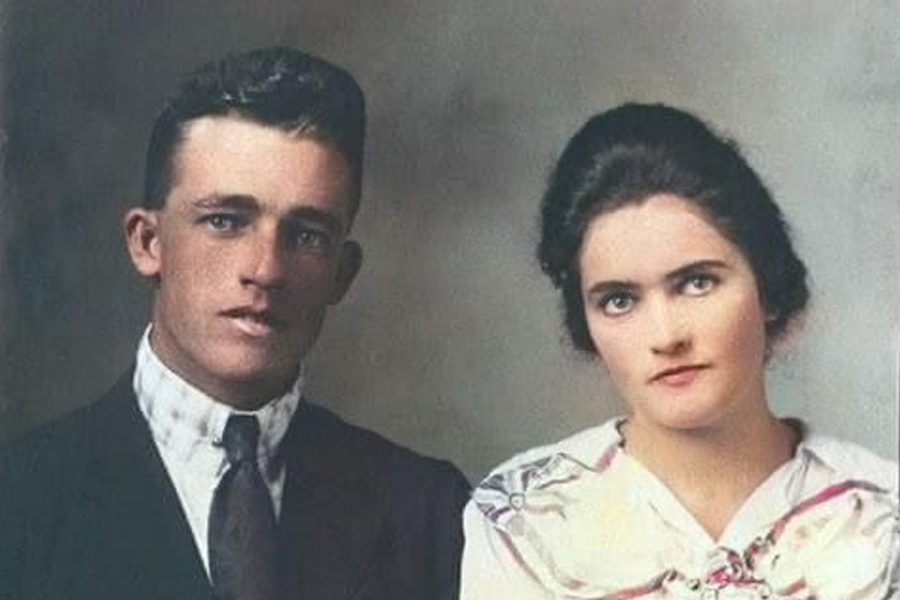
An Arkansas Beginning
I see Flossie Mae Harp as the kind of woman history often leaves in soft focus, while the louder people around her step into the spotlight. She was born in Arkansas in 1902, in a world still shaped by dirt roads, hard labor, and families that measured time by seasons rather than convenience. Her name carries a plain strength. It sounds like fieldwork, church pews, and a kitchen table worn smooth by years of use.
Her early life is not richly documented in public memory, but the outline is clear enough to matter. She came from the Harp family, daughter of John Bohannon Harp and Martha Frances Arizona Belle Villines Harp. That heritage places her in the thick of a large rural family tree, one rooted in the American South and spread across Arkansas and nearby states. In that setting, identity was built from kinship, duty, and survival. Flossie did not emerge from a stage. She came from a house.
Marriage, Home, and the Making of a Family
On 16 November 1919, Flossie married James Francis Haggard in Checotah, Oklahoma. She was young, only 17, stepping into adult life at a speed that feels startling now but was common then. The marriage became the backbone of her story. From that union came children who would carry the family name forward and, in one case, carry it all the way into American music history.
I think of their life together as a long bridge built plank by plank. The planks were not luxury or ease. They were work, children, moves, grief, and persistence. Flossie and James had at least four children: Lillian Marie, James Lowell, Flora Juanita, and Merle Ronald. Each name marks a different point on the family map.
Lillian Marie Haggard Rea was born in 1921 and lived into 2024, giving the family a living memory that stretched across a century. James Lowell Haggard was born in 1922 and died in 1996. Flora Juanita Haggard was born in 1924 and died very young, a brief flame in the family record. Merle Ronald Haggard, born in 1937, became the most publicly visible member of the family, but the life behind him was formed by the older architecture Flossie had already built.
Children of Flossie Mae Harp
I want to lay out the family clearly, because Flossie’s life is inseparable from the people around her.
| Family Member | Relationship to Flossie Mae Harp | Notes |
|---|---|---|
| James Francis Haggard | Husband | Married in 1919 |
| Lillian Marie Haggard Rea | Daughter | Born 1921, lived until 2024 |
| James Lowell Haggard | Son | Born 1922, died 1996 |
| Flora Juanita Haggard | Daughter | Born and died in 1924 |
| Merle Ronald Haggard | Son | Born 1937, country music legend |
That table only gives the bones. The feeling lives in the details. Lillian carried the family story into modern times. James Lowell remained part of the family line even if public attention rarely lingered on him. Flora Juanita’s short life reminds me that family history is not only made of fame and achievement. It is also made of absences. And Merle, the youngest, turned the family’s private hardship into public art.
The Move West and the Shape of Hardship
The Haggards fled Oklahoma for California in 1934 after a barn fire and the Great Depression. This migration was unglamorous. Circumstance prompted the march. Not all families move for better conditions. Staying is heavier, so they move.
The family lived in a converted boxcar in Bakersfield when Merle was born in 1937. I remember the vision. Boxcars aren’t designed as homes. It holds freight, not dreams. Flossie created a life there, or helped maintain one. That requires silent stubborn grace.
The Church of Christ shaped her home, which had rigid, steadfast, and anchored ideals. The backdrop mother was not decorative. She ruled. She appears to have shaped the family’s morality, norms, order, and accountability.
Work, Money, and Survival
Flossie’s own career trail is narrow in the historical record, but it matters. After James died in 1946, she took bookkeeping work to help support the family. That detail tells me more than a job title ever could. Bookkeeping is careful work. It is the discipline of numbers, of balance, of making sure the totals hold. In a family with limited means, it becomes something like a hidden engine.
I do not see evidence of wealth, formal accolades, or a public career independent of her children. Her economic life was likely practical and lean. That is not a lack. It is a different kind of achievement. She kept the household moving through hard years. She did not inherit ease. She manufactured endurance.
Flossie and Merle Haggard
Flossie’s fame comes largely from Merle, a strong emotional connection. He became one of country music’s most defining voices, and many learned about his mother from his songs and stories. The song “Mama Tried” became Flossie a famous icon of motherhood, discipline, and love. This transition might be unjust but illuminating.
I believe Flossie is Merle’s artistic foundation. She was the stern hand, spiritual frame, and family pillar while the world collapsed. Merle’s public life grew larger than hers, yet his work returned to the environment she created.
Family Legacy Across Generations
Flossie’s legacy extends through her grandchildren, especially those connected to Merle. The names include Dana, Marty, Kelli, Noel, Jenessa, and Ben Haggard. Several of them followed musical paths, carrying forward the family’s public relationship with performance, memory, and country music tradition.
Here is the generational shape as I see it:
| Generation | Names |
|---|---|
| Parents of Flossie | John Bohannon Harp, Martha Frances Arizona Belle Villines Harp |
| Flossie’s siblings | William Ollis Harp, Opal Harp Hiner, Flora Agnes Harp Newton, and possibly others in extended records |
| Flossie’s spouse | James Francis Haggard |
| Flossie’s children | Lillian Marie, James Lowell, Flora Juanita, Merle Ronald |
| Flossie’s grandchildren through Merle | Dana, Marty, Kelli, Noel, Jenessa, Ben |
Family trees like this can look tidy on paper. In life, they are tangled vines. Still, the structure helps show how one woman’s life reached outward into several generations.
A Life in Dates
Flossie Mae Harp’s life can be traced by a few important dates, and each one feels like a nail in the wall holding up the larger picture.
1902, born in Arkansas.
1919, married James Francis Haggard.
1921, first child born.
1922, second child born.
1924, daughter Flora Juanita born and died.
1934, family moved west to California.
1937, Merle was born.
1946, James Francis died.
1984, Flossie died in California.
That is the outline. The lived experience between those points was undoubtedly fuller, harsher, and more textured than the record can show.
FAQ
Who was Flossie Mae Harp?
Flossie Mae Harp was an Arkansas-born woman from the early 20th century who became known as the wife of James Francis Haggard and the mother of several children, including Merle Haggard. Her public identity is tied to family life, religious discipline, and the difficult move west during the Depression.
Why is Flossie Mae Harp remembered today?
I remember her because she stood at the center of a family that later became widely known through Merle Haggard. She is also remembered as the woman whose values, hardships, and household discipline helped shape one of country music’s major voices.
How many children did Flossie Mae Harp have?
She had at least four children: Lillian Marie, James Lowell, Flora Juanita, and Merle Ronald Haggard. These four names anchor the family line most clearly in public records and family memory.
What kind of work did Flossie Mae Harp do?
After James Francis Haggard died, she worked as a bookkeeper. Before that, she is often described as a homemaker and family anchor. Her work was practical, steady, and necessary, especially during years of scarcity.
Did Flossie Mae Harp have a public career or finances of her own?
I do not see evidence of a public career in the usual sense, nor do I find reliable details about personal wealth or finances. Her life was documented mainly through family history rather than business or celebrity records.
What is Flossie Mae Harp’s connection to Merle Haggard?
She was Merle Haggard’s mother. Her influence appears in the family environment that shaped him and in the broader emotional world that his music drew from. Her role in his life was foundational, like the frame beneath a house.
Where did Flossie Mae Harp live later in life?
After the family moved to California in 1934, she lived in the Bakersfield area. Her later years are associated with California, where she died in 1984.
Are there many details about her personal life?
Only a limited number of details are widely available. Most of what survives centers on her marriage, her children, her move west, her work after widowhood, and her role in shaping a notable family lineage.