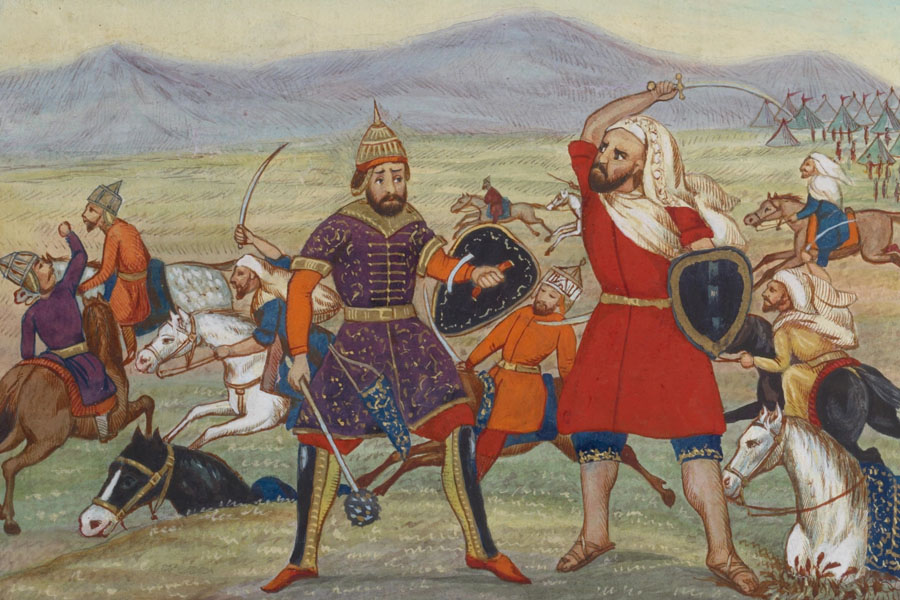
A Personal Dive into Ancient Persian Valor
I’ve always loved stories of soldiers who stayed firm as civilizations fell. Rostam Farrokhzad masterfully portrays that spirit. He ruled huge armies and shaped Persian greatness after being born into one of the Sasanian Empire’s strongest aristocratic houses in the late 590s to early 610s CE. Ispahbudhan members carried Parthian and Kayanid lineages. His 40-year existence was full of drama, strategy, and sacrifice to last centuries. He was the shield that delayed the storm long enough for history to notice.
He ruled Adurbadagan, a northwest quarter. After that, he commanded the entire imperial army. Between 628 and 636 CE, domestic strife and foreign invasions shaped the empire’s decline. Scholars believe he was born in the northwest on family estates near modern Azerbaijan. In 631 CE, he took Ctesiphon, the capital. After turmoil, he restored order. He led one of the greatest Persian armies in the Battle of al Qadisiyyah in 636 CE. A clash killed him and precipitated the empire’s fall. He often reminds me of a cornered lion screaming to the end.
The Family Ties That Defined His Path
Family formed the bedrock of Rostam Farrokhzad’s power and purpose. The Ispahbudhan house ranked among the seven elite noble families of the Sasanian realm. They intermarried with royalty and controlled vast lands armies and revenues. I find it striking how closely his personal story intertwined with his relatives’ ambitions and tragedies. Only two immediate family members appear in the records yet their influence shaped every major decision he made.
Here is a clear overview in table form for quick reference.
| Family Member | Relation | Key Role and Details |
|---|---|---|
| Farrukh Hormizd | Father | Powerful prince and spahbed of Adurbadagan. First cousin to King Khosrow II. Led rebellion in 627 to 628 CE. Attempted to marry Queen Azarmidokht. Murdered around 630 to 631 CE. Passed titles lands and Pahlav faction leadership to his sons. |
| Farrukhzad | Younger Brother | High ranking noble and military figure in Ctesiphon. Succeeded Rostam as spahbed after 636 CE. Defended the capital fought at the Battle of Jalula. Retreated northward. Linked to the founding of the Bavand dynasty in Tabaristan ruling from 651 to 665 CE and beyond. Received a famous prophetic letter from Rostam urging continued defense of Iran. |
Farrukh Hormizd the patriarch built the family’s peak influence. He participated in the deposition of Khosrow II during the Byzantine Sasanian War. His murder by Queen Azarmidokht ignited Rostam Farrokhzad’s vengeful campaign. That single act of betrayal in 630 CE changed everything. Rostam captured Ctesiphon blinded and killed the queen then restored Queen Boran to the throne in June 631 CE. I see this as more than revenge. It was a son honoring his father’s legacy while securing the empire’s stability.
Farrukhzad the brother carried the torch forward. After Rostam’s death he defended key positions and facilitated some northern resistance. Later traditions tie him to ruling Tabaristan with descendants like his son Surkhab I who preserved Sasanian traditions for generations. No wives children or other siblings appear in any accounts. The focus stayed strictly on duty and bloodline honor. Even in the Shahnameh a poetic letter from Rostam to Farrukhzad mentions their unnamed mother in a farewell that drips with sorrow and foresight. These bonds turned a noble house into a kingmaking force during the empire’s darkest hours.
Military Career Achievements and the Final Campaign
Rostam Farrokhzad quickly extended hereditary governorships. He was spahbed of Adurbadagan and co-ruler with regents under Queen Boran and young King Yazdegerd III during the civil wars of 628–632 CE. Military elephants and elite cavalry were among his enormous army. Administration included revenue collection, diplomacy, and province stabilization. Avenging his father, capturing the capital, and deposing a rival queen in 631 CE were notable achievements. That reinstated Boran as the empire’s strongest figure.
He supported Yazdegerd III’s coronation in 632 CE. He constructed fortifications against Arab advances. He negotiated and fortified near al Qadisiyyah for months in 634–636 CE. He led one of the largest Persian armies. Several tens of thousands of troops and specialized units are estimated. He delayed the conquest and gave the empire time. Feudal nobles’ finances are lost to time. He relied on enormous family estates, tax rights, and private armies, not modern treasuries. His money sponsored his campaigns without question.
He became famous for his ultimate stand at al Qadisiyyah in November 636 or May 637 CE. His death in combat amid chaotic wounds or a sandstorm is reported. Early records called it Battle Day of Rostam. I see it as the old order’s breaking point. His preparations allowed his brother and others to resist northward until 651 CE.
An Extended Timeline of Key Moments
To grasp the scale of his impact I mapped his life against major dates. This timeline reveals how quickly events escalated.
- Late 590s to early 610s CE: Birth into the Ispahbudhan family.
- 627 to 628 CE: Joins father in rebellion that deposes Khosrow II.
- 630 to 631 CE: Avenges father’s murder captures Ctesiphon kills Queen Azarmidokht restores Queen Boran in June 631 CE assumes spahbed title.
- 632 CE: Supports coronation of Yazdegerd III becomes commander in chief.
- 634 to 636 CE: Mobilizes defenses camps at al Qadisiyyah for months of negotiations.
- November 636 CE or around May 637 CE: Dies at the Battle of al Qadisiyyah.
- 636 to 651 CE: Brother Farrukhzad succeeds him defends Ctesiphon fights at Jalula retreats northward aids holdouts in Tabaristan.
- 651 to 665 CE and beyond: Farrukhzad and descendants rule in northern Iran preserving the family line.
These 40 plus years compressed enough upheaval to fill volumes. Each date marks a pivot that kept the empire breathing a little longer.
FAQ
Who exactly was Rostam Farrokhzad in the Sasanian Empire?
Rostam Farrokhzad was a high born military commander from the House of Ispahbudhan. He held the title of spahbed of Adurbadagan and later served as overall commander in chief. Active from the late 590s to 636 CE he navigated civil wars restored queens and led the final major defense against invasion. His role blended generalship administration and kingmaking at the empire’s end.
How did his father Farrukh Hormizd influence his rise?
Farrukh Hormizd a powerful prince and first cousin to Khosrow II built the family’s status through rebellion and political maneuvering. His murder in 630 CE sparked Rostam Farrokhzad’s campaign that captured Ctesiphon and reshaped succession. The father’s titles lands and faction leadership passed directly to Rostam turning personal loss into imperial power.
What happened to his brother Farrukhzad after the great battle?
Farrukhzad younger brother and fellow noble succeeded Rostam as spahbed. He defended Ctesiphon fought at the Battle of Jalula then retreated north. By 651 CE he helped establish or continue the Bavand dynasty in Tabaristan ruling until at least 665 CE. His line including son Surkhab I kept Sasanian resistance alive for generations.
Why does the Battle of al Qadisiyyah mark such a turning point?
Fought in 636 CE the battle saw Rostam Farrokhzad command vast Persian forces against Arab armies. His death there in combat amid chaos or storm signaled the collapse of central Sasanian power. It delayed but could not stop the conquest. The event earned the name Battle Day of Rostam highlighting its symbolic weight.
How does his story appear in Persian literature?
In the Shahnameh Rostam Farrokhzad emerges as a wise warrior and astrologer who foresaw doom. A famous letter to his brother urges defense of Iran and consoles family. The epic blends his real military feats with legendary flair making him a symbol of bravery and sacrifice that still inspires today.